MVP vs PoC: Unraveling the Differences
Guest: James Studdart26 Jun 2023 | 0 Comments
In the journey of software development, key milestones carry significant weight. Two of these are the Proof of Concept (PoC) and Minimum Viable Product (MVP)...
26 Jun 2023 | 0 Comments
In the journey of software development, key milestones carry significant weight. Two of these are the Proof of Concept (PoC) and Minimum Viable Product (MVP)...In the journey of software development, key milestones carry significant weight. Two of these are the Proof of Concept (PoC) and Minimum Viable Product (MVP). Both are crucial, but they serve distinct purposes and are uniquely different. Let’s delve into their differences, their importance, and the sequence of their implementation.
A PoC is an early-stage realisation of a certain method or idea to demonstrate its feasibility. It serves as the prototype to confirm the practicality and potential impact of a specific idea. It’s about validating whether a concept can be developed in the real world before it’s fully realised. The core question that a PoC answers is: “Can this idea be implemented?” A PoC plays a vital role in risk mitigation, cost-effectiveness, and fostering understanding among stakeholders.
While a PoC and an MVP both serve as steps toward the final product, it’s crucial to understand that a PoC is not an MVP. A PoC is a small project, utilised for validating the feasibility of an idea. It does not represent the final product and is generally used internally within an organisation to prove the concept works.
The intent behind a PoC is to answer the question, “Can we build this?” rather than “How will the market react to this?” After a PoC has achieved its purpose — proving that the concept is feasible — it has essentially served its role. The PoC should be treated largely as a disposable entity, a stepping stone towards the real product. Although some code or learnings may transition into the MVP, most will not.
Join Medium for free to get updates from this writer.
In essence, a PoC is a learning tool and a building block, not a smaller version of the final product.
An MVP, on the other hand, is the most pared-down version of a product that can still deliver value to customers. The focus of an MVP is learning what resonates with your target audience and getting feedback for future product development. It is designed to answer questions like “Should this product be developed?” and “Does this product deliver value?”
An MVP is a fundamental part of the lean startup methodology and plays a critical role in the product development process. It helps in:
Typically, a PoC precedes an MVP in the software development process. A PoC helps to verify that an idea is technically feasible, while an MVP further builds on a validated idea to see if it has market value. To simplify, a PoC is about feasibility (“Can we build it?”), and an MVP is about viability and desirability (“Should we build it?” and “Do users find it valuable?”).
Whether you’re considering a PoC or MVP, James Studdart and his team at can guide you through these crucial stages of software development. Their expertise can provide the clarity and technical proficiency needed to navigate these milestones successfully.
For more insights and to discuss your software project requirements, feel free to connect with James Studdart via his LinkedIn profile or visit the website.
Begin your software journey today, and turn your innovative ideas into successful realities with PoCs and MVPs!
Please leave a comment, positive, negative or just something weird.
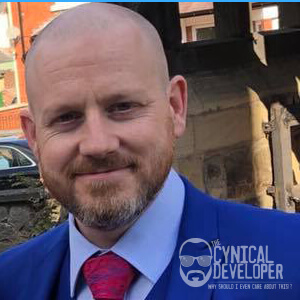
James Studdart - Expert Software Consultant, Mentor, Innovator & Author - Transforming Ideas into Delivered Solutions
Not only the engaging host of The Cynical Developer Podcast but also a master of bespoke software solutions. With a diverse skill set that encompasses .Net, Python, C#, JavaScript, graphic design, and web development, he is a coding genius and a true innovator in the field. As the founder of this popular tech podcast, James stays ahead of the game, consistently transforming ideas into delivered solutions. His role as an expert software consultant, mentor, and author showcases his ability to guide and inspire others in the tech industry.


Find us on all your favourite podcast platforms, and social platforms as well.